
What Foreign Investment Companies Underestimate When Entering the Middle East
Published:

Foreign investment in the Middle East needs more than company registration, available capital and an attractive business proposal. Companies entering Saudi Arabia, the United Arab Emirates or Jordan must understand the local investment environment, government development priorities, institutional relationships, market demand and the operational conditions that determine whether a project can actually work.
The region offers substantial opportunities and investment programs but the business establishment process is frequently approached in the wrong order. Market research, feasibility studies, government incentives and corporate setup all matter.
According to the United Nations Trade and Development (UNCTAD) World Investment Report 2025, the UAE attracted approximately USD 45.6 billion in foreign direct investment in 2024, an increase of 48.7% compared with 2023. Saudi Arabia recorded approximately USD 15.7 billion under UNCTAD's international reporting methodology. These figures show considerable investment activity, but also differences between national markets. And the figures alone tell an investor very little about whether a particular factory, service business, technology company or regional headquarters will be commercially successful.
The problem is that foreign companies often begin with incorporation. They select a jurisdiction, appoint legal representatives, prepare documentation and establish a company or representative office. Only afterwards do they discover that the industrial site needs different zoning, that infrastructure is insufficient, that their business activity requires additional approvals or that a relevant government investment programme should have been investigated before making those commitments.
The first question for foreign investors should not be how to register a company in the Middle East. It should be whether the proposed business is commercially, institutionally and operationally feasible in the selected market.
Why Middle East Market Entry Requires a Different Business Approach
Saudi Arabia, the UAE and Jordan should not be treated as one business environment simply because they share regional, cultural and commercial connections. Their economic priorities, investment legislation, regulatory structures, available incentives and business operating models differ. Even within the UAE, choosing between Dubai, Abu Dhabi and other emirates can significantly affect licensing, industrial development options, operating costs and institutional support.
Foreign investors, particularly companies from Europe and the former Soviet Union, sometimes approach Middle Eastern expansion through familiar corporate models. They expect that incorporating a legal entity, appointing management and preparing an initial business plan will create a sufficient foundation for operations. In reality, the legal establishment of a business and the development of an investment project are two different processes.
One establishes a legal presence. The other determines whether the proposed operation can be financed, licensed, supplied, staffed, delivered and commercially sustained.
This distinction becomes especially important for capital-intensive projects, including manufacturing, logistics, industrial services, healthcare, technology infrastructure and large B2B operations. Such projects may involve several government authorities, sector regulators, infrastructure providers, financial institutions and commercial stakeholders long before the company generates revenue.
Regional Business Expansion and Setup Frameworks: What Should Come First?
I think one of the most expensive mistakes in international expansion is treating business setup as an administrative assignment rather than an investment decision. Legal registration is important, but it should follow the initial assessment of the project, not replace it. Before committing substantial capital, companies need a regional business expansion and setup framework that connects commercial research, institutional engagement, corporate structure and operational requirements.
A practical framework should include:
- Market study and demand analysis: assess market size, potential customers, competitors, pricing, purchasing behaviour and expected market growth;
- Commercial feasibility: test projected revenue, operating expenses, margins, customer acquisition assumptions and financial sustainability;
- Technical and operational feasibility: determine site requirements, utilities, logistics, workforce availability, equipment and supplier capacity;
- Regulatory assessment: identify foreign ownership conditions, sector restrictions, required licences, permits and applicable standards;
- Government and institutional mapping: determine which authorities influence investment approval, infrastructure, incentives and development support;
- Investment programme assessment: investigate applicable industrial, economic development, export, employment and investment support programmes;
- Corporate establishment planning: compare legal entities, branch structures, free zones, development zones and operating locations;
- Risk and implementation planning: identify critical dependencies, approval timelines, capital requirements and decision-making responsibilities.
What happens when these assessments are postponed? Companies may spend months establishing a business that does not fit the most suitable investment structure. They may negotiate expensive premises before confirming infrastructure availability or prepare financial forecasts that do not reflect local labour, utility, compliance and logistics costs. Business registration cannot correct a fundamentally weak market-entry decision.
This is why strategic marketing and market research should connect directly with commercial planning and operational feasibility, particularly when companies are entering unfamiliar international markets.
Government and Institutional Relations Should Begin Before Company Establishment
One of the most underestimated aspects of Middle Eastern investment is understanding which government institutions are relevant to the proposed project. Foreign investors may begin with lawyers, incorporation agents, accountants or business setup consultants. These specialists are necessary, but they do not always assess whether the project aligns with national investment priorities or whether institutional support is available.
In my opinion, government and institutional relations should be incorporated into the early feasibility stage. This does not mean requesting special treatment or assuming that government support will be granted. It means identifying the appropriate public authorities, understanding their responsibilities and presenting the project through the correct official channels.
Early institutional discussions may help investors clarify:
- Whether the proposed business activity is encouraged under national or sector development strategies;
- Which government body acts as the principal investment facilitator;
- Whether sector-specific incentives, industrial programmes or development zones are relevant;
- What foreign ownership, licensing and establishment conditions apply;
- Whether suitable industrial land and infrastructure are available;
- Which technical, environmental and municipal approvals may be required;
- Whether workforce development, training, export or financing support programmes should be assessed;
- Which additional government agencies or public-sector stakeholders should participate in the discussions.
And this is where experienced corporate advisory becomes valuable. A government institution does not necessarily need another general presentation about a promising business idea. It needs enough information to understand what the project will produce, what investment it requires, which economic contribution it may generate and what specific institutional coordination is being requested.
There is also a clear distinction between an introductory meeting, an expression of institutional interest and an official approval. None should be presented to shareholders or financiers as a guaranteed incentive or government commitment.
Foreign Investment in Saudi Arabia: Align the Project With National Development Priorities
Saudi Arabia has developed an investment environment closely connected with Vision 2030, industrial diversification, localisation, logistics development, technology and national economic priorities. For foreign companies, the opportunity is not limited to establishing a commercial office in Riyadh or selling products to KSA customers. Depending on the sector, investors may explore local production, industrial partnerships, supply-chain development and regional corporate operations.
The Invest Saudi platform, associated with the Saudi Ministry of Investment, provides information about investment opportunities, sectors, investor services and available programmes. It is a logical starting point for understanding the investment environment before selecting a legal structure.
Which KSA Government Bodies Should Foreign Investors Approach?
Depending on the nature of the project, relevant institutions may include:
- Ministry of Investment (MISA): foreign investment requirements, investor services and investment facilitation;
- Ministry of Industry and Mineral Resources: industrial development and sector requirements;
- MODON: industrial cities, industrial land and related infrastructure;
- Saudi Industrial Development Fund (SIDF): financing programmes for eligible industrial and other supported activities;
- Economic Cities and Special Zones Authority: relevant economic cities and special economic zone frameworks;
- Relevant sector regulators and municipal authorities: technical licensing, operating permits and location-specific requirements.
Saudi Investment Incentives and Regional Headquarters
Saudi Arabia offers different forms of investment support, including selected industrial financing, workforce development measures, industrial land arrangements and special economic zone benefits. The Kingdom also has a Regional Headquarters programme intended for qualifying multinational companies establishing regional management functions in Saudi Arabia.
However, the existence of an incentive does not establish eligibility for every foreign company. Conditions may depend on the legal entity, business activity, location, investment scale, Saudi employment commitments and the specific programme. A regional headquarters arrangement should not be confused with an operating manufacturing entity or a commercial branch. Each serves a different corporate purpose.
For example, a European manufacturer exploring KSA should determine whether it intends to produce locally, import and distribute products, establish a regional management office or combine several functions. That decision can change the required licences, investment structure, staffing and operating model.
The corporate structure should support the actual business activity, not simply follow the most convenient registration route.
Foreign Investment in the UAE: Mainland, Free Zones and Emirate-Level Opportunities
The UAE offers a different set of business establishment choices. Investors can consider mainland entities, free zone companies and branches, while certain activities require additional regulatory approvals. Dubai and Abu Dhabi also maintain distinct investment ecosystems, sector priorities and institutional support mechanisms.
One common misconception is that a free zone company is automatically the best choice for every foreign investor. Free zones may offer operational and administrative advantages, but suitability depends on business activities, customers, permitted operations, physical location and the regulatory treatment of transactions outside the zone.
For industrial projects, logistics companies and businesses supplying the wider UAE market, the location and licensing structure should be evaluated against the actual operating model. A lower initial registration cost does not necessarily produce a lower total operating cost.
Which UAE Investment Authorities Should Companies Contact?
Two particularly relevant official starting points are:
- Invest in Dubai: the official Dubai business establishment and investment portal, providing information on mainland licensing, legal structures and business setup;
- Invest in Abu Dhabi: an official investment information platform for businesses assessing opportunities and support within Abu Dhabi.
Other relevant institutions may include the Abu Dhabi Investment Office (ADIO), emirate-level economic development authorities, free zone authorities and industry-specific regulators. The right contact depends on whether the project concerns manufacturing, technology, finance, healthcare, logistics or another regulated sector.
A manufacturing investor, for example, should assess industrial land, electricity, water, transport links, environmental permits, technical requirements and proximity to ports or major customers before selecting its establishment location.
And honestly, it makes little commercial sense to choose an industrial location based primarily on the attractiveness of its business setup package. The factory must operate efficiently for years after the initial licence has been issued.
Foreign Investment in Jordan: Understanding Investment Incentives and Industrial Opportunities
Jordan's investment proposition should be evaluated according to the project's business model, workforce requirements, regional trade opportunities, infrastructure and expected customer geography.
For foreign companies considering manufacturing, business services, technology, logistics or export-oriented activities, the Jordan Ministry of Investment and Invest Jordan platform provides information about investment opportunities, legislation, incentives and investor services.
Jordan's Investment Environment Law No. 21 of 2022 established an investment framework covering investor rights, institutional services and incentives. Amendments to the Investment Environment Regulation published in June 2026 further addressed licensing procedures, investment facilitation and the scope of selected incentives.
Which Jordanian Institutions Are Relevant?
Depending on the proposed activity, a foreign company may need to engage with:
- Ministry of Investment: investment opportunities, investor facilitation, applicable incentives and development zones;
- Ministry of Industry, Trade and Supply: commercial and industrial policy and relevant business requirements;
- Companies Control Department: company registration and corporate records;
- Jordan Industrial Estates Company: industrial estate opportunities and associated infrastructure;
- Municipal, environmental and sector authorities: land use, construction, environmental and operating approvals;
- Relevant customs, tax and workforce authorities: requirements associated with the proposed operating model.
Investment Incentives Need to Be Included in the Feasibility Study
Jordan's investment framework includes incentives associated with qualifying activities, locations and economic development objectives. Depending on the project's circumstances, these may involve customs treatment, tax provisions, development zones, employment commitments or other support mechanisms.
For instance, manufacturing activities in qualifying development zones may receive different treatment from businesses operating elsewhere in the country. Additional investment benefits may also depend on official decisions, conditions and compliance requirements.
The important point is not that incentives are available in principle. It is whether the specific investor, business activity and location qualify under the applicable legislation and current programme conditions.
For a foreign investor assessing Jordan, it is therefore necessary to compare the commercial benefits of different locations alongside utilities, labour, logistics, market access and regulatory requirements. An incentive that appears attractive on paper may have limited value if it increases delivery costs or places the business too far from its customers.
Market Research and Feasibility Studies Must Go Beyond Market Size
Another frequent problem is the quality of market research. A company may purchase an industry report, collect a few macroeconomic indicators and conclude that a market is attractive because it has a large population, rising investment or growing consumption. That information can be useful, but it does not establish commercial feasibility.
A growing industry does not automatically mean there is accessible demand for a new foreign supplier. Existing distribution arrangements, long-term supply contracts, customer qualification requirements, price sensitivity and local competition can all limit market entry.
For B2B and industrial investments, a serious market study should investigate:
- Potential customers and their actual purchasing requirements;
- Existing suppliers, market concentration and competitor capabilities;
- Import dependence and opportunities for local substitution;
- Current prices, distribution margins and purchasing contracts;
- Product standards, technical qualifications and customer approval processes;
- Realistic market penetration and achievable sales volumes;
- Relevant regional export opportunities and trade conditions;
- Customer willingness to enter long-term supply or cooperation arrangements.
Financial feasibility should then connect realistic demand with capital expenditure, fixed and variable operating costs, working capital, taxes, customs treatment, financing costs and cash-flow assumptions. Where infrastructure is critical, technical feasibility must confirm availability and connection requirements rather than relying on general statements about an area's development potential.
This is also where marketing and corporate strategy should work together. A well-developed marketing consulting and strategic business advisory process helps connect customer research, competitive positioning and commercial assumptions with the wider investment decision.
In my experience, the purpose of research is not to produce an impressive report. It is to identify which assumptions are supported, which remain uncertain and which could make the investment commercially unviable.
Why Foreign Investors Should Present Their Projects Before Establishing a Company
There is considerable value in preparing an investment project profile before proceeding with company incorporation or branch registration. Not every institution will provide detailed project-specific guidance to a foreign company before establishment, and some formal applications require a registered entity. Nevertheless, preliminary discussions can clarify which procedures, programmes and authorities are relevant.
A suitable introductory project profile should normally address:
- Project overview: proposed activity, products or services and business objectives;
- Investment structure: estimated capital commitment and intended financing approach;
- Market opportunity: target customers, commercial demand and competitive position;
- Economic contribution: potential employment, local procurement, exports, training and technology transfer;
- Operational requirements: land, facilities, utilities, logistics and workforce;
- Implementation plan: preliminary milestones, dependencies and target operating timeline;
- Institutional requirements: questions about regulations, investment support, incentives and relevant government coordination.
The same presentation should not necessarily be sent unchanged to every stakeholder. A government investment agency may focus on economic contribution and sector alignment. A bank will assess financing, ownership, compliance and repayment capacity. An industrial zone operator will want to understand the physical and technical requirements. Commercial partners will focus on products, volumes, specifications and delivery capacity.
Executive communication must respond to the stakeholder's actual decision-making responsibilities. This is a corporate advisory function as much as a communication task.
Corporate Operations and Governance Are Part of the Investment Decision
Foreign investors sometimes separate the investment project from the company that will eventually operate it. Shareholders discuss capital and returns, lawyers prepare the corporate documents, HR handles recruitment and consultants prepare the business plan. Meanwhile, responsibility for coordinating the entire process remains unclear.
This creates a difficult situation when one decision depends on several others. An industrial site may not be suitable without sufficient electricity or water. Equipment delivery may depend on construction progress. Banking arrangements may require particular corporate documentation. Executive employment arrangements can depend on immigration rules and the selected legal entity.
Before operations begin, companies should establish:
- Corporate governance and executive reporting structures;
- Shareholder, board and management responsibilities;
- Delegated authority and approval limits;
- Contracting and procurement procedures;
- Government and institutional communication responsibilities;
- Legal, tax, accounting and compliance coordination;
- Recruitment, employment and workforce planning;
- Operational milestones, risk registers and reporting procedures.
As a business and marketing consultant with more than 20 years of experience, I have repeatedly seen how weaknesses in internal coordination affect external business results. A commercially promising project can lose momentum because decisions are fragmented, responsibilities are undefined or important technical and administrative details are identified too late.
This is why the development of SOPs, management systems and executive responsibilities should begin during project preparation, not after the company becomes operational.
For international investors, the greatest risk is not always choosing the wrong market. It is entering a potentially suitable market with the wrong assumptions, incomplete information and an operational structure that cannot support the investment.
A Practical Pre-Investment Checklist for Middle East Market Entry
Before committing to a company, representative office, branch or major local investment, I would recommend that foreign investment companies discuss customers, authorities, legal structure, make their own research and assign the right people, willing to immerce, or knowing the region well.
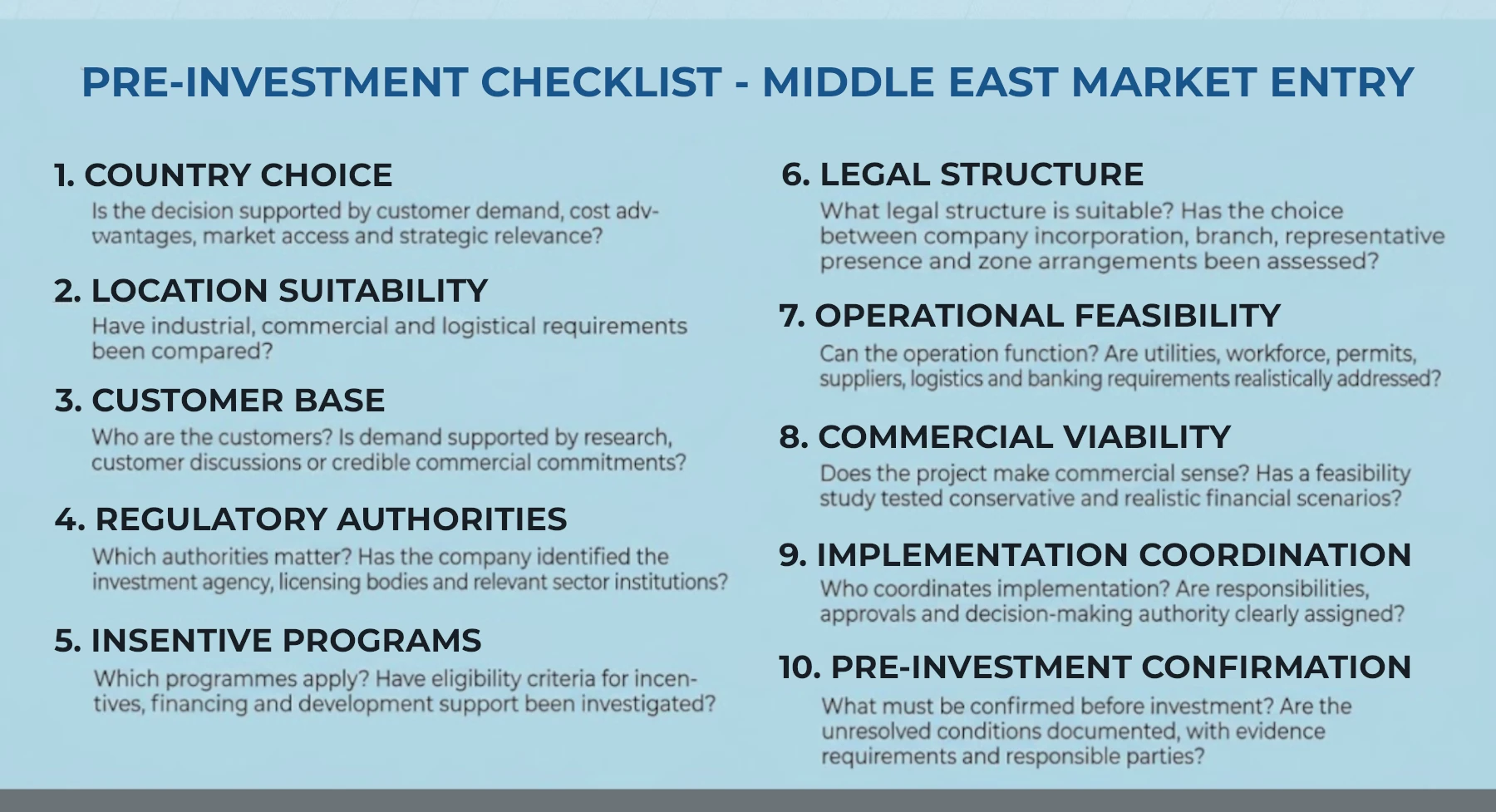
Not every question can be fully resolved before legal establishment. Some processes can begin only after registration. However, investors should know which issues remain open and which commitments depend on their resolution.
A structured investment decision is not one without uncertainty. It is one where uncertainty has been identified, assessed and incorporated into the implementation plan.
How Katra Marketing Supports Foreign Companies Entering Middle Eastern Markets
At Katra Marketing, we provide Marketing Consulting and Executive Advisory services for international businesses, including companies from the European Union and former USSR countries, considering expansion into Saudi Arabia, the UAE, Jordan and other Middle Eastern markets.
Our advisory approach connects marketing strategy with the broader business requirements of international expansion. We work with business owners, executives and investors to understand the commercial logic of a proposed market entry, identify gaps in planning and prepare structured recommendations for decision-making.
Depending on the project, our consulting scope can include:
- Regional business expansion research: country and location comparisons, commercial opportunities and market-entry assessments;
- Market studies and competitive analysis: customer segments, demand evaluation, industry conditions, competitors and market positioning;
- Commercial feasibility studies: evaluation of revenue assumptions, pricing, market demand, commercial risks and business-model viability;
- Business and marketing diagnostics: identification of strategic gaps, internal weaknesses and market-readiness issues;
- Government and institutional stakeholder mapping: identifying relevant investment authorities, sector institutions and potential development programmes;
- Executive advisory: decision-making support, cross-functional coordination, corporate planning and strategic priorities;
- Corporate operations advisory: organisational structures, management responsibilities, processes, SOPs and implementation planning;
- Investment and corporate presentations: preparation of project profiles and stakeholder-specific business communication materials;
- Go-to-market and marketing strategies: market positioning, B2B development, customer acquisition and commercial communication planning.
For projects requiring legal opinions, engineering verification, tax structuring, statutory valuations or specialised regulatory approvals, the relevant work should be performed or validated by qualified local professionals. Our advisory role is to help clients establish the business logic, coordinate the necessary workstreams and make better-informed executive decisions.
And this is perhaps the most important point. Entering the Middle East should not be treated as a competition to obtain the fastest company registration. It is an investment decision that requires market knowledge, realistic financial assumptions, institutional understanding and the ability to organise multiple business functions around one commercial objective.
Before establishing a company, make sure there is a clear reason for establishing it, a credible plan for operating it and enough reliable information to justify the investment.
Research and Official Investment Resources
- United Nations Trade and Development (UNCTAD), World Investment Report 2025: International Investment in the Digital Economy, 2025. Read PDF report.
- UNCTAD, World Investment Report 2025, Saudi Arabia Country Fact Sheet, 2025. Read PDF fact sheet.
- UNCTAD, World Investment Report 2025, United Arab Emirates Country Fact Sheet, 2025. Read PDF fact sheet.
- Ministry of Investment of Jordan, Investment Licensing Manual, official guidance. Read PDF manual.
- Ministry of Investment of Jordan, Amended Investment Environment Regulation Published in the Official Gazette, June 2026. Read official announcement.
Note: Investment programmes, regulations and incentive eligibility may change. Foreign companies should verify current conditions directly with the relevant authorities and qualified local advisors before making legal or financial commitments.
About the Author

About Katra Marketing

